
PLUSPETROL
End-to-end aerial documentation of oversized energy equipment moving from inland highway convoys through port transfer and final vessel stowage.
The challenge
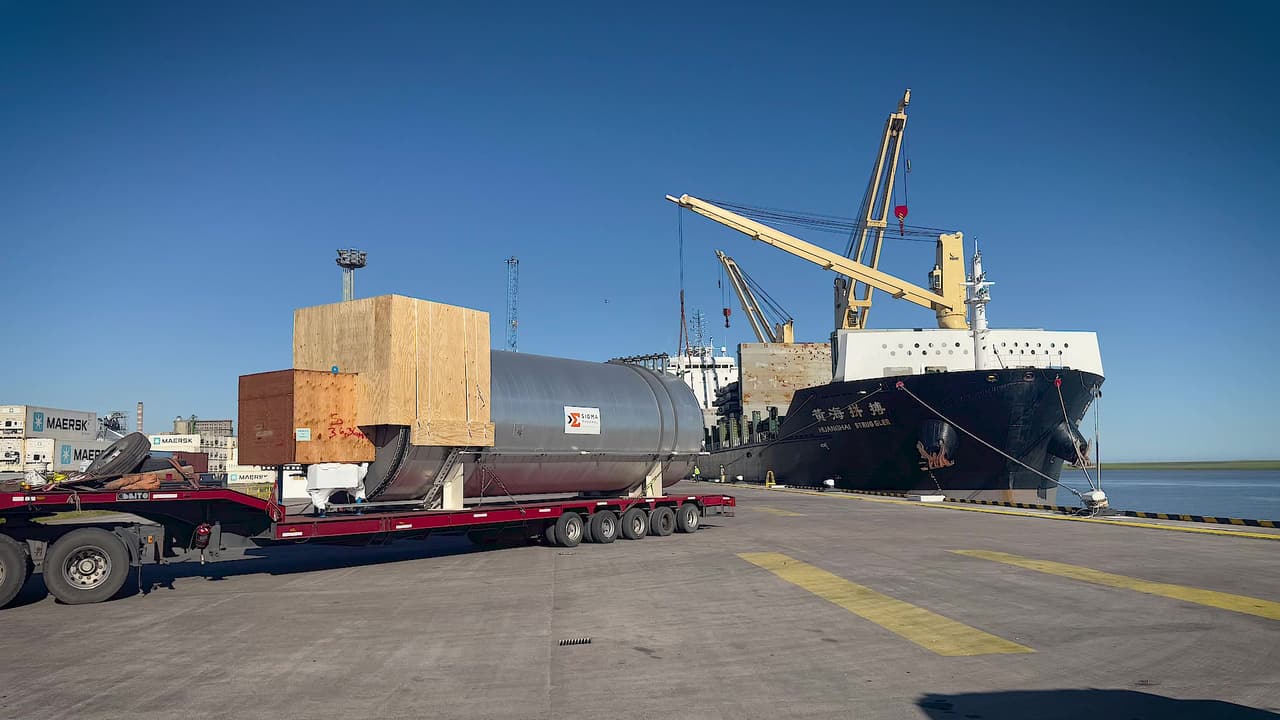
The operation unfolded across changing terrain and several handoff points. Highway transport, terminal arrival, crane positioning, loading, and final stowage each needed to read as part of one continuous project rather than as disconnected moments.
The approach
Coverage followed the cargo journey at the scale appropriate to each phase. Wide aerial passes established the convoy within the route and surrounding terrain; vertical frames documented lane position, spacing, and hold geometry; lower oblique views brought the equipment, vessel, and field crew into the same visual story.
Oversized project cargo is difficult to explain with isolated images. The equipment may be visible in each frame, but the real story is the chain of planning and coordination that carries it from an inland route to a secured position inside an ocean-going vessel.
For PLUSPETROL, the coverage was built around that full journey. The highway sequences show the scale of the loads against open terrain and the discipline of the convoy formation. Directly overhead, the route becomes measurable: vehicle position, lane clearance, spacing, and surrounding traffic can all be read in one view.
At the port, the visual language shifts from movement to placement. Wide views establish the vessel and terminal; vertical frames look directly into the holds to document module orientation, deck clearances, and the final wrapped cargo before closure. Including the pilot and active berth gives the record a human point of reference without losing the industrial scale.
Project films
The opening film above establishes the complete operation. The second cut concentrates on the marine-transfer phase and carries the story through vessel loading and stowage.
Together, the films and stills turn a long, multi-stage logistics operation into a clear case study: where the cargo traveled, how it was handled, and how the final transport configuration came together.
The result
PLUSPETROL received a cohesive visual record of the project cargo journey from inland movement to secured marine transport. The final films and stills make the operation understandable at a glance while preserving the route, transfer, and stowage details needed for a credible project record.
Gallery